Events

Thursday 23 April 2026 11:45 am
Bushwakkers
SGS Speaker Series – Multi-Scale Controls on Vein-Type Orogenic Gold Precipitation and Remobilization in the Malartic-Val-d’Or District of the Abitibi Subprovince (Québec, Canada) – Michi Herzog
Multi-Scale Controls on Vein-Type Orogenic Gold Precipitation and Remobilization in the Malartic-Val-d’Or District of the Abitibi Subprovince (Québec, Canada)
Michael “Michi” Herzog – Geologist, Global Exploration, Nutrien Ltd.
Abstract
Brittle-ductile reverse shear zones are the most important host for orogenic gold mineralization globally. These reverse shear zones are known to form by common physical processes associated with orogenic cycles, at post-peak metamorphic conditions. Crustal shortening periods induce regional-scale reverse shear zones that act as main conduits for ascending hydrothermal fluids, forming mesothermal quartz-carbonate veins. Fluid source reservoir(s), physico-chemical processe(s) and the timing that lead to gold precipitation within these veins have been the subject of long-standing research activities, particularly focusing at the deposit- and orebody-scale. Nevertheless, the nature of these parameters remains elusive at the orogenic gold district-scale, commonly encompassing regional, km- wide vein fields. In this presentation, we will use a combination of micro-analytical chemical and isotopic techniques to assess spatial and temporal controls on several gold orebodies contained in the world-class Malartic-Val-d’Or district of the southern Neoarchean Abitibi Subprovince (Canada).
Structurally-controlled gold deposit clusters in this district are distributed along the E-W striking Larder Lake-Cadillac-fault-zone and hosted in lower-order structures that cut volcanic rocks and intrusions of the greenstone belt. In these structures, gold is commonly associated with two vein sets that form pre- or syn- the regional-penetrative fabric (S2) developed during major N-S shortening and peak-metamorphism. This include: (1) highly-deformed quartz-carbonate veins entrained in the S2-fabric and (2) laminated brittle-ductile quartz-tourmaline-carbonate reverse-shear and sub-horizontal extension-veins that are sub-parallel to oblique to the S2-fabric. The latter form part of the Val-d’Or Vein Field (VVF), which contains the bulk of orogenic gold in the Malartic-Val-d’Or district.
Throughout this presentation, we will explore various regional macro- to micro-scale features recorded across nine gold orebodies (Kiena-S50, Canadian Malartic East, Kiena-Deep, Goldex, Triangle, Plug #4, Beaufor, Pascalis Gold Trend and Akasaba West) to tackle three key topics:
- The regional scale and timing of auriferous hydrothermal events in the area through the lens of in-situ U-Pb geochronology.
- Physico-chemical processes controlling gold saturation in auriferous hydrothermal fluids monitored through in-situ sulfide multiple sulfur isotope and trace element compositions.
- BiTe-nanoparticle formation associated with a regional post-mineralization hydrothermal overprint of gold hosted in pyrite at the nano-scale by transmission electron microscopy.
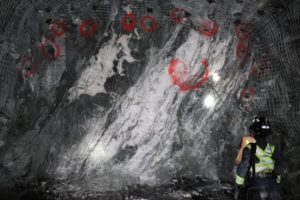
Figure 1: Typical gold-bearing brittle-ductile reverse-shear zone of the Val-d’Or Vein Field (facing West).
Bio
Michael “Michi” Herzog, originally from southern Austria, completed his B.Sc. and M.Sc. degrees at the Technical University of Munich and Ludwig-Maximilian-University (both Munich, Germany). For his M.Sc. thesis he spent a year with the Centre for Exploration Targeting at the University of Western Australia (Perth, Australia) and conducted field work in Argentina, examining the geochemical alteration footprint of the epithermal Farallón Negro deposit (NW Argentina). He then went on to complete his Ph.D. degree with the Metal Earth research group at Université Laval, involving numerous partners across industry and academia and where he had the chance to conduct field work within the prestigious and world-class Malartic-Val-d’Or district of the southern Abitibi Subprovince (Québec, Canada). His Ph.D. thesis deciphered multi-scale controls on orogenic gold mineralization and characterized geochemical signatures associated with distinct hydrothermal events that played key roles in the gold endowment and formation of the Malartic-Val-d’Or district. Since completion of his Ph.D. degree, he shifted his focus towards the “pink gold” and is currently working as a Geologist-in-Training (APEGS – GIT) with the Global Exploration Team at Nutrien Ltd. (Saskatchewan, Canada), where he evaluates the potential of global potash mineral projects and supports execution of underground and surface mine site projects across the Nutrien potash network.
Talk Registration Form
Upcoming Events