

Events
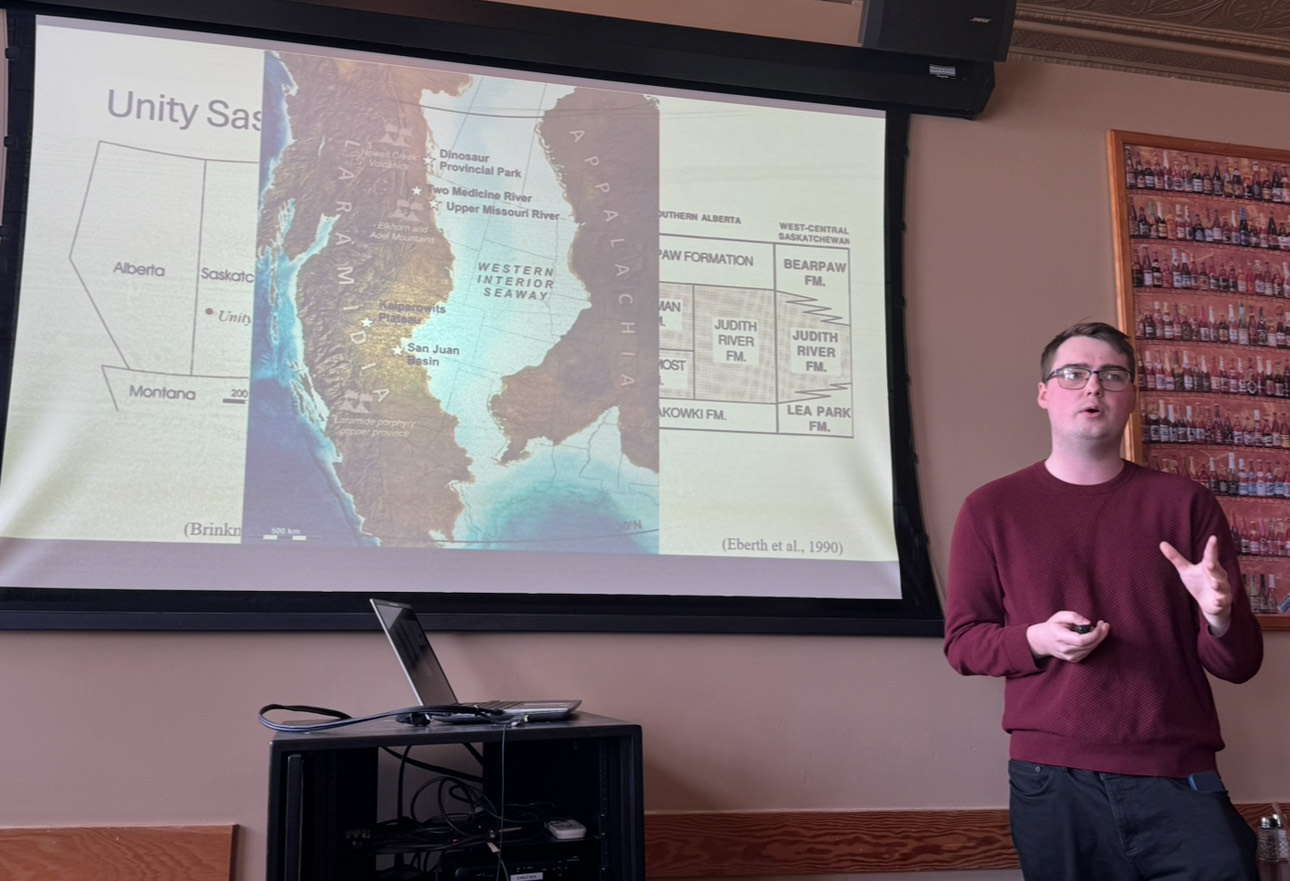
Ben Egan, “Reconstructing Anomalous Dinosaur Food Webs using the Geochemistry of Amber”
Abstract
Carbon isotopes have consistently been used in modern ecosystems to determine dietary preference of animals. When applied to Cretaceous herbivorous dinosaurs, carbon isotopes seem to falter, being anomalously enriched for animals living in an environment devoid of C4 plants. Recent work has demonstrated that this enrichment is occurring in all Cretaceous vertebrates, potentially caused by unknown environmental conditions occurring during this time. Despite this carbon isotope enrichment being observed within the majority of the Cretaceous food web, most C3 plant proxies do not record this degree of enrichment. The only C3 plant proxy record which displays similar levels of carbon isotope enrichment to Cretaceous animals is the fossilized form of tree resin, amber. By comparing carbon isotopes from both amber and vertebrate enamel from the Unity bonebed, Saskatchewan we were able to accurately place hadrosaur and ceratopsian dinosaurs as C3 plant consumers. Interestingly both tyrannosaur and dromaeosaur taxa have similar values to marine animals, potentially a result of Unity’s close proximity to the Western interior seaway. Our results suggest that the likely cause of carbon isotope enrichment during the Cretaceous is a result of atmospheric conditions enriching the isotopic values of C3 plants. As a greenhouse world, the ecosystem dynamics of the Cretaceous provide an extreme case study for future climate change and can be used to model potential challenges in modern food webs. Significantly more research is required to fully comprehend the abnormalities of Cretaceous ecosystems; we hope this project highlights the role that amber and Saskatchewan palaeontology can play in Mesozoic research.
Bio:
Ben is a MSc student at the University of Regina and Royal Saskatchewan Museum supervised by Maria Velez and Ryan McKellar. Described as a “paleontologist who plays with isotopes”, Ben’s current project focuses on solving a long-standing issue in geochemical reconstructions of Cretaceous animals. Ben completed his BSc in Geology with year abroad at the University of Durham, England and studied at Vrije Universiteit Amsterdam, Netherlands for one year.
